Transmission Repair & Service IN NORTH SEATTLE
AAA-approved auto repair • ASE-certified technicians • Trusted by Seattle-area drivers for more than 30 years
Your vehicle’s transmission transfers engine power to the wheels while selecting the gear ratio needed for starting, accelerating, cruising, climbing hills, and slowing down. When transmission operation changes, you may notice slipping, delayed engagement, harsh shifting, unusual noises, warning lights, fluid leaks, or a vehicle that will not move normally.
At Chuck’s Auto Repair – North Seattle, we provide professional transmission inspections, diagnostics, maintenance, and qualifying repairs for drivers throughout North Seattle. Our ASE-certified technicians evaluate the vehicle’s symptoms, scan the appropriate computer systems, inspect the fluid and related components, and perform vehicle-specific testing before recommending service or repair.
A shifting problem does not automatically mean the transmission has failed internally. Similar symptoms may be caused by low voltage, engine-performance concerns, sensors, wiring, fluid leaks, mounts, CV axles, wheel-speed signals, control modules, or other drivetrain components.
We diagnose the cause before recommending an expensive transmission repair or replacement.
📞 Call (206) 526-1069 or Schedule Transmission Service Online.
What Does the Transmission Do?
The transmission controls how engine power is delivered to the wheels.
It allows the vehicle to:
- Start moving from a stop
- Accelerate through different speed ranges
- Maintain efficient engine speed while cruising
- Reverse
- Handle hills and changing loads
- Transfer power smoothly
- Reduce engine speed at highway speeds
- Provide engine braking in applicable driving conditions
Depending on the vehicle, the transmission system may include:
- Automatic transmission
- Continuously variable transmission
- Dual-clutch transmission
- Manual transmission
- Torque converter
- Clutch assemblies
- Valve body
- Hydraulic pump
- Solenoids
- Gears
- Bearings
- Shafts
- Internal chains or belts on applicable designs
- Transmission control module
- Sensors
- Wiring and connectors
- Transmission fluid
- Fluid filter
- Cooler and cooler lines
- Shift linkage or electronic shifter
- Mounts
- Differential components on transaxle designs
Transmission designs vary widely, so the correct fluid, testing procedure, maintenance interval, and repair method must match the specific vehicle.
Common Signs of a Transmission Problem
Your vehicle may need transmission or drivetrain inspection if you notice:
- Transmission slipping
- Delayed engagement into drive or reverse
- Harsh or abrupt shifting
- Shifting at unexpected times
- Engine speed increasing without matching acceleration
- Vehicle hesitating before moving
- Transmission will not shift into a gear
- Vehicle will not move
- Grinding or whining
- Shuddering during acceleration
- Vibration during engagement
- Fluid leaking beneath the vehicle
- Burning odor
- Transmission warning message
- Check engine light
- Vehicle entering reduced-power or limp mode
- Manual transmission difficult to shift
- Clutch slipping
- Transmission overheating warning
- Vehicle rolls unexpectedly in park
- Unusual noise that changes with gear selection
- Repeated need to add transmission fluid
- Transmission operating differently when hot or cold
These symptoms can be caused by internal transmission failure, but they may also involve the engine, electrical system, drivetrain, controls, mounts, or fluid level.
Testing is needed before determining the repair.
Transmission Problems Do Not Always Mean Transmission Failure
A vehicle may shift poorly even when the internal transmission is still serviceable.
Possible causes outside the transmission include:
- Weak battery
- Charging-system problem
- Low system voltage
- Engine misfire
- Throttle-body concern
- Airflow or fuel-delivery problem
- Faulty wheel-speed sensor
- Damaged wiring
- Poor electrical ground
- Control-module communication problem
- Worn engine or transmission mount
- CV axle concern
- Differential problem
- Shift-linkage concern
- Brake-switch input
- Software or adaptation concern
- Tire-size mismatch on some vehicles
Modern transmissions depend on information from multiple vehicle systems.
A fault in one of those systems may change shift timing, pressure control, engagement, or available gears.
That is why transmission diagnosis should include more than checking the fluid or reading one trouble code.
Types of Vehicle Transmissions
Different transmission designs require different service procedures.
Conventional Automatic Transmission
A conventional automatic transmission commonly uses:
- Torque converter
- Planetary gearsets
- Clutch packs
- Hydraulic pressure
- Valve body
- Electronic solenoids
It selects gear ratios automatically based on speed, load, throttle position, computer commands, and other inputs.
Continuously Variable Transmission
A continuously variable transmission, commonly called a CVT, changes ratios without using the same fixed gear steps found in many traditional automatic transmissions.
Depending on the design, it may use:
- Steel belt
- Chain
- Pulleys
- Hydraulic pressure
- Electronic controls
- Specialized fluid
CVTs require the correct manufacturer-approved fluid and service procedure.
Dual-Clutch Transmission
A dual-clutch transmission uses two clutch systems to manage alternating gear sets.
It may operate automatically but has mechanical and control characteristics that differ from a conventional automatic transmission.
Some dual-clutch systems use wet clutches, while others use dry clutches.
Manual Transmission
A manual transmission requires the driver to select gears using a clutch pedal and shift lever.
The system may include:
- Clutch disc
- Pressure plate
- Flywheel
- Release bearing
- Pilot bearing
- Synchronizers
- Shift linkage
- Hydraulic clutch components
- Gear oil or manual-transmission fluid
Automated Manual Transmission
Some vehicles use a manual-style internal transmission operated by electronic or hydraulic actuators.
These systems may require specialized diagnosis, adaptation, or calibration.
We identify the transmission design before recommending fluid service or repair.
Why Is My Transmission Slipping?
Transmission slipping may feel like the engine speed rises without the vehicle accelerating as expected.
Possible causes include:
- Low transmission fluid
- Fluid leak
- Worn internal clutch components
- Hydraulic pressure loss
- Solenoid concern
- Valve-body problem
- Torque-converter concern
- Internal seal leakage
- Incorrect fluid
- Overheated fluid
- Electronic control fault
- CVT belt, chain, or pulley concern
- Manual clutch wear
Slipping can create heat and additional internal damage.
If the vehicle is slipping, avoid heavy acceleration, towing, or continued driving until the concern is evaluated.
A fluid service alone does not repair worn internal clutch material or a confirmed mechanical failure.
Why Does My Vehicle Take Time to Move After Selecting Drive or Reverse?
Delayed engagement means the vehicle does not begin moving promptly after drive or reverse is selected.
Possible causes include:
- Low fluid level
- Internal hydraulic leakage
- Fluid draining from a circuit while parked
- Valve-body concern
- Solenoid problem
- Worn internal seals
- Pump concern
- Torque-converter issue
- Electronic command problem
- Shift linkage or range-sensor concern
- Internal clutch wear
The delay may be more noticeable:
- During the first start of the day
- When the transmission is cold
- After the vehicle sits for several hours
- When the transmission is hot
- When selecting only one direction
The operating conditions help direct the diagnostic process.
Why Is My Transmission Shifting Harshly?
Harsh shifting may involve:
- Incorrect hydraulic pressure
- Low or contaminated fluid
- Solenoid fault
- Valve-body wear
- Transmission adaptation issue
- Sensor input problem
- Engine-performance concern
- Worn mount
- Internal clutch concern
- Control-module fault
- Software-related issue
- Mechanical transmission damage
A vehicle may shift harshly because the computer has placed the system into a protective operating mode.
The cause should be diagnosed before clearing codes or resetting adaptations.
Why Is My Transmission Shuddering?
Shuddering may feel like vibration, shaking, or driving over a rough surface.
Possible causes include:
- Torque-converter clutch concern
- Contaminated or incorrect fluid
- Internal clutch operation
- CVT concern
- Dual-clutch wear
- Engine misfire
- Worn engine or transmission mount
- CV axle
- Driveshaft
- Tire or wheel concern
- Differential problem
A torque-converter shudder can feel similar to an engine misfire.
Road testing, scan data, operating conditions, and related system checks help identify the source.
Why Is My Transmission Making Noise?
Transmission and drivetrain noises may include:
- Whining
- Grinding
- Humming
- Clunking
- Rattling
- Buzzing
- Clicking
Possible causes include:
- Low fluid
- Internal bearing wear
- Pump concern
- Gear wear
- Torque converter
- Differential
- CV axle
- Wheel bearing
- Driveshaft
- Mount
- Engine concern
- Transfer case
- Tire noise
The noise may change with:
- Vehicle speed
- Engine speed
- Selected gear
- Acceleration
- Deceleration
- Turning
- Transmission temperature
Because several systems can produce similar sounds, the noise should be confirmed before the transmission is blamed.
Transmission Fluid Leaks
Transmission fluid helps lubricate, cool, clean, and operate internal components.
Possible leak locations include:
- Transmission pan
- Drain or fill plug
- Pan gasket
- Axle seals
- Input or output shaft seals
- Cooler lines
- Cooler fittings
- Transmission case
- Electrical connector seal
- Valve-body cover
- Torque-converter area
- Differential seals
- Transmission fluid cooler
Fluid may travel along the transmission, subframe, or underbody before reaching the ground.
The drip location may not be directly below the source.
A leak should be evaluated based on:
- Fluid level
- Leak rate
- Location
- Risk of internal damage
- Possibility of fluid contacting hot components
- Related transmission symptoms
Adding fluid without repairing the leak may temporarily restore the level but does not correct the problem.
What Does Transmission Fluid Do?
Depending on the transmission design, the fluid may:
- Lubricate gears and bearings
- Apply hydraulic pressure
- Operate clutch assemblies
- Transfer power through the torque converter
- Manage heat
- Carry contaminants to the filter
- Support valve-body operation
- Protect seals
- Reduce wear
- Operate pulleys or clutch systems in specialized transmissions
Transmission fluids are not interchangeable.
A vehicle may require:
- Automatic transmission fluid
- CVT fluid
- Dual-clutch fluid
- Manual-transmission fluid
- Gear lubricant
- Manufacturer-specific formulation
Using the wrong fluid may cause poor operation, noise, clutch problems, pressure concerns, seal damage, or transmission failure.
Using the Correct Transmission Fluid
Correct fluid selection may depend on:
- Vehicle year
- Make and model
- Transmission code
- Transmission design
- Manufacturer specification
- Fluid friction characteristics
- Temperature requirements
- Clutch material
- Hydraulic control design
Fluid color alone does not determine compatibility.
Two fluids with similar colors may have different friction characteristics, and fluids with different colors may serve similar applications.
We verify the manufacturer-required specification before adding or replacing transmission fluid.
How Often Should Transmission Fluid Be Serviced?
There is no single service interval for every transmission.
The correct interval may depend on:
- Manufacturer recommendations
- Transmission type
- Mileage
- Time
- Fluid specification
- Driving conditions
- Towing
- Commercial use
- Repeated short trips
- Mountain driving
- Heat exposure
- Service history
Some manufacturers publish a regular interval.
Others recommend inspection or service only under certain operating conditions.
A transmission described as having “lifetime” fluid may still require attention if the fluid is contaminated, the vehicle operates under severe conditions, or repairs require fluid replacement.
The vehicle-specific maintenance schedule should be the starting point.
What Is Severe Transmission Service?
Operating conditions that may increase fluid temperature or transmission load include:
- Towing
- Carrying heavy loads
- Frequent stop-and-go driving
- Extended idling
- Commercial or delivery use
- Mountain driving
- Repeated short trips
- High ambient temperatures
- Off-road use
- Frequent low-speed operation
- Snow-plow or heavy accessory use on applicable vehicles
Whether those conditions require a different service interval depends on the manufacturer.
We do not apply the same severe-service schedule to every vehicle.
Transmission Fluid Drain and Refill
A drain-and-refill service removes the fluid released through the transmission’s drain point or pan and replaces it with the correct amount and specification.
Because some fluid may remain inside the:
- Torque converter
- Cooler
- Cooler lines
- Valve body
- Internal passages
A single drain and refill may not replace all the fluid in the system.
A drain-and-refill service may include:
- Verifying the correct fluid
- Draining accessible fluid
- Inspecting the drain plug
- Replacing a sealing washer when required
- Refilling using the correct procedure
- Checking fluid level at the specified temperature
- Inspecting for leaks
- Resetting or recording maintenance information when applicable
The exact procedure varies by transmission.
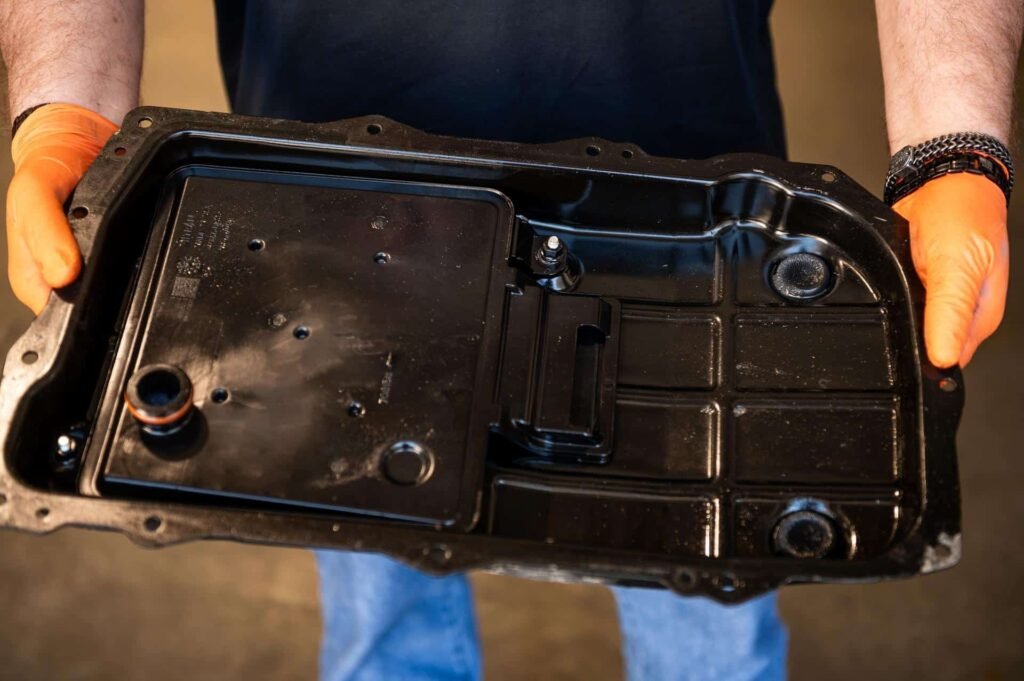
Transmission Pan and Filter Service
Some automatic transmissions use a removable pan and serviceable filter.
A pan and filter service may include:
- Removing the transmission pan
- Inspecting the fluid
- Inspecting the pan for debris
- Cleaning the pan and magnets
- Replacing the filter when serviceable
- Replacing the pan gasket or sealing material
- Reinstalling the pan
- Refilling with the correct fluid
- Setting the fluid level
- Checking for leaks
Not every transmission has a serviceable filter.
Some filters are internal and require significant disassembly.
Others are built into a replacement pan assembly.
The procedure must match the transmission design.
Transmission Flush vs. Fluid Service
The term “transmission flush” is often used broadly, but service methods differ.
Possible methods include:
- Drain and refill
- Pan and filter service
- Fluid exchange
- Manufacturer-specific service procedure
A fluid exchange replaces more fluid than a basic drain and refill, but it does not repair:
- Worn clutches
- Damaged gears
- Low hydraulic pressure
- Failed solenoids
- Valve-body wear
- Torque-converter failure
- Internal bearing damage
A transmission already slipping, grinding, or showing evidence of major internal wear should be diagnosed before routine fluid exchange is recommended.
We choose the service method based on the vehicle, manufacturer procedure, fluid condition, symptoms, and service history.
Can Changing Transmission Fluid Cause a Failure?
A proper fluid service does not normally create an internal mechanical failure.
However, a transmission may already have:
- Worn clutch material
- Internal leakage
- Contamination
- Low hydraulic pressure
- Severe overheating damage
- Incorrect fluid
- Existing slipping
- Delayed engagement
- Significant debris in the pan
Fresh fluid cannot reverse physical wear.
In some heavily worn transmissions, old contaminated fluid may be one part of a larger failing system. The transmission may continue to deteriorate after service because the underlying damage was already present.
That is why symptoms and fluid condition should be evaluated before routine maintenance is performed.
Transmission Fluid Level Checks
Checking transmission fluid is not the same on every vehicle.
Some transmissions have:
- Dipstick
- Sealed fill system
- Level plug
- Temperature-dependent overflow procedure
- Electronic fluid-level information
- Manufacturer-specific scan-tool requirements
The vehicle may need to be:
- Level
- Running
- At a specified fluid temperature
- Shifted through specific gear positions
- Checked with special tools
Incorrect fluid level may cause:
- Slipping
- Foaming
- Harsh shifts
- Delayed engagement
- Overheating
- Leakage
- Internal damage
Both underfilling and overfilling can create problems.
Transmission Fluid Condition
Transmission fluid may darken during normal use.
Fluid condition should be evaluated using more than color alone.
Important factors include:
- Odor
- Contamination
- Metal debris
- Clutch material
- Water or coolant contamination
- Correct fluid type
- Service interval
- Operating symptoms
- Transmission temperature
- Fluid level
Burned odor, heavy debris, or metallic material may indicate internal wear or overheating.
Fluid inspection can provide useful evidence, but it does not replace complete diagnosis.
Transmission Overheating
Excessive transmission temperature can damage fluid, seals, clutches, bearings, and electrical components.
Possible causes include:
- Low fluid
- Heavy towing
- Restricted cooler
- Failed cooling fan
- Engine cooling-system problem
- Internal slipping
- Incorrect fluid
- Excessive vehicle load
- Repeated stop-and-go operation
- Torque-converter concern
- Cooler-line restriction
- Internal transmission failure
Possible signs include:
- Overtemperature warning
- Burning odor
- Harsh or delayed shifts
- Limp mode
- Darkened fluid
- Slipping
- Reduced vehicle performance
A transmission that overheats repeatedly should be diagnosed before continued use causes additional damage.
Transmission Cooler and Cooler-Line Problems
Many automatic transmissions circulate fluid through a cooler.
The cooler may be:
- Built into the radiator
- Mounted separately in front of the radiator
- Part of a heat-exchanger assembly
- Controlled by valves or thermostatic components
Cooler-related concerns may include:
- Fluid leak
- Restricted flow
- Damaged hose
- Corroded metal line
- Contamination
- Internal radiator failure
- Inadequate cooling
- Connection leak
A cooler restriction may contribute to overheating.
When a transmission is replaced after a major internal failure, the cooler and lines may require cleaning, testing, or replacement to prevent contamination from reaching the replacement assembly.
Coolant and Transmission Fluid Mixing
On some vehicles, the transmission cooler is built into the engine radiator.
An internal failure may allow:
- Coolant to enter the transmission fluid
- Transmission fluid to enter the cooling system
- Both fluids to become contaminated
This can cause severe damage to:
- Transmission clutch material
- Bearings
- Seals
- Valve body
- Cooling system
- Hoses
- Radiator
Abnormal fluid in the coolant reservoir or transmission should be investigated promptly.
Transmission Solenoids
Solenoids are electronically controlled valves that help manage:
- Gear changes
- Hydraulic pressure
- Torque-converter clutch operation
- Fluid routing
- CVT ratio control
- Clutch application
A solenoid concern may cause:
- Harsh shifting
- Missing gear
- Delayed engagement
- Limp mode
- Trouble codes
- Slipping-like symptoms
- Torque-converter concerns
A code associated with a solenoid does not automatically prove the solenoid itself has failed.
The cause may involve:
- Wiring
- Connector
- Power or ground
- Valve-body wear
- Hydraulic pressure
- Internal mechanical concern
- Control module
Electrical and hydraulic testing may be needed before replacement.
Transmission Valve Body
The valve body directs hydraulic fluid through passages and valves to control transmission operation.
Possible valve-body concerns include:
- Sticking valves
- Wear in hydraulic bores
- Solenoid problems
- Pressure loss
- Contamination
- Electrical faults
- Internal leakage
Symptoms may include:
- Harsh shifts
- Delayed shifts
- Wrong gear
- Shift flare
- Slipping sensation
- Limp mode
- Trouble codes
Some valve bodies can be serviced separately.
Others require calibration, programming, adaptation, or internal transmission work.
Torque Converter Problems
The torque converter transfers power between the engine and an automatic transmission.
It may also use an internal lockup clutch to improve efficiency.
Possible torque-converter symptoms include:
- Shudder
- Slipping
- Overheating
- Noise
- Stalling when stopping
- Poor acceleration
- Lockup-related trouble codes
- Excessive debris in the fluid
A torque-converter concern may resemble:
- Engine misfire
- Transmission slip
- Mount problem
- Drivetrain vibration
- CV axle concern
Diagnosis should confirm the source before the converter or transmission is replaced.
Transmission Control Module and Electronic Problems
Modern transmissions use computer controls to manage shifting, pressure, clutch operation, and protective modes.
The system may use information from:
- Engine control module
- Throttle position
- Vehicle speed
- Wheel-speed sensors
- Brake switch
- Transmission temperature
- Gear-selector position
- Engine torque
- Steering or stability-control systems
Electronic concerns may involve:
- Transmission control module
- Wiring
- Connector corrosion
- Low voltage
- Poor ground
- Sensor
- Solenoid
- Network communication
- Software or calibration
A transmission warning light does not automatically mean internal transmission replacement is required.
Transmission Limp Mode
Limp mode is a protective strategy that limits transmission operation after the system detects certain faults.
The vehicle may:
- Remain in one gear
- Shift harshly
- Limit acceleration
- Disable certain functions
- Display a warning message
- Turn on the check engine light
Possible causes include:
- Sensor failure
- Solenoid concern
- Low voltage
- Wiring fault
- Overheating
- Incorrect pressure
- Internal mechanical problem
- Module communication fault
Clearing the warning may temporarily restore normal operation, but the fault may return until the cause is repaired.
CVT Service and Diagnostics
Continuously variable transmissions require vehicle-specific service.
Possible CVT symptoms include:
- Shudder
- Delayed engagement
- Whining
- Engine speed flaring
- Poor acceleration
- Overheating
- Warning light
- Limp mode
- Ratio-control codes
- Vehicle will not move
Possible causes include:
- Incorrect or deteriorated fluid
- Low fluid
- Valve-body concern
- Pressure-control problem
- Belt or chain wear
- Pulley damage
- Sensor fault
- Internal bearing wear
- Control-module concern
A CVT must receive fluid that meets the exact required specification.
Conventional automatic transmission fluid should not be used unless specifically approved for that transmission.
Dual-Clutch Transmission Service
Dual-clutch transmissions combine mechanical clutch operation with electronic or hydraulic controls.
Possible concerns include:
- Shudder during takeoff
- Harsh engagement
- Delayed movement
- Clutch overheating
- Gear-selection faults
- Warning messages
- Actuator concerns
- Fluid leaks
- Adaptation problems
Some dual-clutch systems require:
- Specialized fluid
- Clutch adaptation
- Actuator calibration
- Scan-tool procedures
- Temperature-controlled service
A shudder does not automatically mean the complete transmission must be replaced.
The clutch system, controls, mounts, fluid, and adaptations should be evaluated.
Manual Transmission Service
Manual transmission concerns may involve:
- Difficulty selecting gears
- Grinding while shifting
- Gear popping out
- Bearing noise
- Fluid leakage
- Clutch not releasing
- Shift-linkage problems
- Internal synchronizer wear
Possible causes include:
- Low or incorrect fluid
- Clutch hydraulic concern
- Worn clutch
- Shift-cable or linkage problem
- Internal gear wear
- Synchronizer wear
- Bearing damage
- Mounting concern
A manual transmission that grinds does not automatically need replacement.
The clutch, hydraulics, linkage, fluid, and internal transmission should be evaluated.
Clutch Problems That Feel Like Transmission Failure
On a manual-transmission vehicle, clutch problems may cause:
- Slipping
- Hard shifting
- Grinding
- Vehicle not moving normally
- Changed pedal feel
- Shudder
- Burning odor
- Difficulty selecting reverse
- Noise when pressing or releasing the pedal
The concern may involve:
- Clutch disc
- Pressure plate
- Flywheel
- Release bearing
- Pilot bearing
- Master cylinder
- Slave cylinder
- Hydraulic line
- Cable or linkage
The transmission itself may be serviceable even when the clutch system requires repair.
Transmission Mount Problems
Transmission and engine mounts support the drivetrain and help isolate movement and vibration.
A worn mount may cause:
- Clunk during gear engagement
- Excessive drivetrain movement
- Vibration
- Noise during acceleration
- Harsh-feeling shifts
- Movement when selecting drive or reverse
- Stress on hoses, wiring, or axles
Mount symptoms can resemble internal transmission concerns.
The mounts should be inspected when movement or vibration accompanies shifting.
CV Axles, Driveshafts, and Differential Concerns
A vehicle that will not move or produces drivetrain noise may have a problem outside the transmission.
Possible related components include:
- CV axle
- Driveshaft
- Universal joint
- Differential
- Transfer case
- Wheel hub
- Coupling
- Axle splines
Possible symptoms include:
- Clicking during turns
- Clunking
- Vibration during acceleration
- Loss of drive
- Grinding
- Fluid leakage
- Noise that changes with vehicle speed
The complete drivetrain should be evaluated before the transmission is condemned.
Transmission Diagnostics at Chuck’s Auto Repair – North Seattle
Our diagnostic process is designed to identify whether the concern is hydraulic, electronic, mechanical, fluid-related, engine-related, or caused by another drivetrain component.
1. Discuss the Symptoms and History
We ask:
- When did the concern begin?
- Is the problem constant or intermittent?
- Does it occur when hot or cold?
- Which gears are affected?
- Does the engine speed increase?
- Are warning lights on?
- Has fluid been added or serviced recently?
- Has the vehicle been towing?
- Were repairs recently performed?
- Does the problem change after restarting the vehicle?
2. Perform an Initial Inspection
We inspect accessible areas for:
- Fluid leakage
- Fluid level when serviceable
- Damaged wiring
- Connector concerns
- Mount damage
- Cooler-line leaks
- Axle concerns
- Physical damage
- Evidence of previous repair
3. Scan Vehicle Computer Systems
We retrieve applicable trouble codes and review data from systems that may influence transmission operation.
This may include:
- Transmission module
- Engine module
- ABS or stability-control module
- AWD system
- Body or shifter module
A trouble code provides direction but does not automatically identify the failed part.
4. Road Test When Safe
A road test may help evaluate:
- Shift timing
- Engagement
- Slipping
- Shudder
- Noise
- Temperature
- Torque-converter operation
- CVT ratio behavior
- Manual shifting
- Drivetrain vibration
5. Evaluate Fluid Condition
When applicable, we inspect:
- Level
- Odor
- Contamination
- Debris
- Correct fluid
- Evidence of overheating
- Evidence of coolant mixing
6. Test Electrical and Control Circuits
Testing may include:
- Power and ground
- Wiring continuity
- Voltage drop
- Solenoid command
- Sensor inputs
- Transmission range information
- Network communication
- Battery and charging-system condition
7. Evaluate Hydraulic or Mechanical Operation
Depending on the vehicle and concern, testing may include:
- Pressure testing
- Stall-speed testing when appropriate
- Clutch or converter data
- Temperature monitoring
- Pan inspection
- Adaptation values
- Component activation
- Additional internal evaluation
8. Inspect Related Drivetrain Components
We may inspect:
- Mounts
- CV axles
- Driveshaft
- Differential
- Transfer case
- Wheel bearings
- Tires
- Engine operation
9. Explain the Findings and Options
We explain:
- What was confirmed
- Whether the problem is internal or external
- Whether maintenance is appropriate
- Whether an electrical or hydraulic repair is possible
- Whether major transmission repair or replacement should be considered
- Whether further disassembly is required
What Transmission Service May Include
Depending on the vehicle and confirmed findings, transmission service may include:
- Transmission inspection
- Computer diagnostic scan
- Road testing
- Fluid-level inspection
- Fluid-condition evaluation
- Transmission-fluid service
- Pan and filter service when applicable
- Fluid-leak diagnosis
- Seal or gasket repair
- Cooler-line repair
- Electrical circuit testing
- Sensor diagnosis
- Solenoid diagnosis
- Valve-body evaluation
- Range-sensor diagnosis
- Shift-linkage repair
- Mount inspection or replacement
- CVT diagnosis
- Dual-clutch diagnosis
- Manual-transmission diagnosis
- Clutch-system evaluation
- Torque-converter evaluation
- Transmission replacement evaluation
- Post-repair programming or relearn when required
- Post-repair road testing
The exact service depends on the transmission design, manufacturer procedures, test results, and condition of related components.
Transmission Repair vs. Replacement
A transmission concern may have several possible repair options.
These may include:
- Repairing an external fluid leak
- Replacing a damaged sensor
- Repairing wiring
- Replacing a solenoid
- Servicing or replacing a valve body
- Repairing a cooler line
- Correcting a shift-linkage concern
- Replacing a torque converter
- Repairing a manual clutch system
- Replacing the transmission
- Installing a remanufactured transmission
- Installing a used transmission when appropriate
The best option may depend on:
- Extent of internal damage
- Vehicle mileage
- Overall vehicle condition
- Parts availability
- Transmission design
- Cost of repair
- Warranty options
- Condition of the engine and drivetrain
- How long you plan to keep the vehicle
We explain the confirmed findings and practical options before a major decision is made.
New, Remanufactured, and Used Transmissions
When complete replacement is considered, available options may include:
New Transmission
A new unit has not previously been installed or operated.
Availability may be limited, especially on older vehicles.
Remanufactured Transmission
A remanufactured transmission has been disassembled, inspected, repaired, updated where applicable, and reassembled according to the remanufacturer’s process.
Quality and warranty depend on the supplier.
Used Transmission
A used transmission is removed from another vehicle.
Important considerations include:
- Mileage
- Compatibility
- Prior maintenance
- Donor vehicle condition
- Supplier warranty
- Unknown operating history
- Labor required if the used unit fails
We review available options when replacement is confirmed and more than one practical choice exists.
Why Transmission Repair Estimates May Change After Disassembly
Some internal problems cannot be fully identified through external testing.
After the transmission is removed or opened, inspection may reveal:
- Additional clutch damage
- Bearing wear
- Metal contamination
- Gear damage
- Case damage
- Torque-converter debris
- Valve-body wear
- Damaged shafts
- Failed seals
- Cooler contamination
When staged diagnosis or disassembly is required, we explain:
- What has already been confirmed
- Why additional access is necessary
- What remains unknown
- How new findings could affect the repair plan
- What authorization is required before continuing
Can You Drive with a Transmission Problem?
That depends on the symptom and severity.
Reduce driving or arrange inspection promptly if the vehicle has:
- Significant slipping
- Delayed engagement
- No reverse or forward movement
- Grinding
- Heavy fluid leakage
- Overheating warning
- Burning odor
- Severe shudder
- Transmission warning message
- Repeated limp mode
- Vehicle unexpectedly leaving gear
- Engine speed rising without acceleration
Continuing to drive may:
- Increase internal wear
- Overheat the fluid
- Damage the torque converter
- Contaminate the cooler
- Turn a smaller repair into a major failure
- Leave the vehicle unable to move
When unsure, contact the shop and describe the symptoms before continuing to drive.
Preventing Transmission Problems
Not every transmission failure can be prevented, but proper maintenance and early diagnosis may reduce avoidable damage.
Helpful steps include:
- Follow the manufacturer’s fluid-service recommendations
- Use the correct transmission fluid
- Repair fluid leaks
- Maintain the correct fluid level
- Address slipping or delayed engagement promptly
- Investigate warning lights
- Maintain the engine and cooling system
- Avoid exceeding towing or load limits
- Use the correct towing procedure
- Have overheating concerns diagnosed
- Avoid repeatedly shifting between drive and reverse while the vehicle is moving
- Address battery and charging-system problems
- Inspect cooler lines
- Maintain matched tires on AWD vehicles
- Keep transmission-service records
Routine maintenance cannot repair existing internal wear, but it may help protect a transmission that remains in serviceable condition.
Why Choose Chuck’s Auto Repair – North Seattle?
- AAA-approved auto repair facility
- ASE-certified technicians
- Trusted by Seattle-area drivers for more than 30 years
- Professional transmission diagnostics
- Automatic, CVT, dual-clutch, and manual transmission evaluation
- Fluid, leak, electrical, hydraulic, and drivetrain inspection
- Testing before major component replacement
- Vehicle-specific fluid and service procedures
- Clear explanations of repair options
- 24-month / 24,000-mile parts and labor warranty
- 12-month / 12,000-mile nationwide warranty coverage
- Convenient North Seattle location
We do not assume every shifting problem requires transmission replacement.
We inspect the complete system and determine whether the concern involves fluid, electronics, controls, external components, engine operation, or internal transmission damage.
Warranty Protection for Qualifying Transmission Repairs
Qualifying transmission and drivetrain repairs are backed by our 24-month / 24,000-mile parts and labor warranty.
The warranty also includes 12-month / 12,000-mile nationwide coverage, providing additional protection if you need warranty assistance while traveling away from Seattle.
The nationwide 1-800 assistance information is printed on every repair invoice. Customers also receive a warranty keytag for convenient access while on the road.
Warranty coverage depends on the repair performed, parts or assemblies installed, supplier terms, and applicable warranty conditions.
Convenient Transmission Service in North Seattle
Chuck’s Auto Repair – North Seattle
9115 Roosevelt Way NE
Seattle, WA 98115
We provide transmission inspections, diagnostics, maintenance, and qualifying repairs for drivers throughout:
Maple Leaf • Roosevelt • Northgate • Green Lake • Wedgwood • University District • Ravenna • Lake City • Wallingford • Greenwood
📞 Call (206) 526-1069 to schedule transmission service.
Transmission Service FAQs
How do I know whether my transmission is failing?
Common signs include slipping, delayed engagement, harsh shifting, grinding, shuddering, fluid leaks, warning lights, or a vehicle that will not move normally. Testing is needed because other vehicle systems can produce similar symptoms.
Does a transmission warning light mean I need a new transmission?
No. The warning may involve a sensor, wiring, solenoid, overheating, low voltage, fluid concern, control module, or internal problem.
Why does my engine rev without the vehicle accelerating?
Possible causes include transmission slip, manual clutch slip, CVT concern, low fluid, hydraulic-pressure loss, or internal wear.
Why does my vehicle jerk when shifting?
Possible causes include a solenoid, valve body, fluid condition, engine-performance problem, mount, adaptation issue, sensor input, or internal transmission concern.
Why is there a delay when I shift into drive or reverse?
Possible causes include low fluid, internal hydraulic leakage, valve-body wear, solenoid problems, worn seals, pump concerns, or electronic controls.
Can low transmission fluid cause slipping?
Yes. Low fluid can reduce hydraulic pressure and lubrication. The source of the fluid loss should also be identified.
Can I add transmission fluid myself?
Some vehicles have complex temperature-dependent level procedures and no dipstick. Using the wrong fluid or incorrect amount may damage the transmission.
What color should transmission fluid be?
Color varies by fluid type and age. Condition should be evaluated using specification, odor, contamination, debris, mileage, and transmission symptoms—not color alone.
Does dark transmission fluid always mean the transmission is bad?
No. Fluid may darken during use. Burned odor, heavy debris, contamination, and operating symptoms provide more meaningful information.
How often should transmission fluid be changed?
The interval depends on the manufacturer, transmission type, fluid, mileage, time, and operating conditions.
Should I get a transmission flush?
The appropriate service may be a drain and refill, pan and filter service, fluid exchange, or another manufacturer-approved procedure. A transmission with serious symptoms should be diagnosed before routine fluid service.
Can changing the transmission fluid make it fail?
A proper service does not normally create internal wear. However, fresh fluid cannot repair a transmission that already has worn clutches, pressure loss, overheating damage, or another internal failure.
Can an engine problem feel like a transmission problem?
Yes. Misfires, throttle concerns, low power, sensor faults, and control-system problems may affect shifting or feel like transmission slip.
Can a bad transmission mount cause hard shifting?
A worn mount may make normal gear engagement feel harsh or cause clunking and excessive drivetrain movement.
Can a bad CV axle feel like a transmission problem?
Yes. A damaged axle may cause vibration, clunking, clicking, or loss of drive.
What is transmission limp mode?
Limp mode limits transmission operation after the computer detects a fault. It is designed to reduce further damage and allow limited operation in some cases.
Can a CVT be serviced like a regular automatic transmission?
No. CVTs require vehicle-specific fluid and procedures. Conventional automatic transmission fluid may not be compatible.
Why does my transmission operate differently when it is cold?
Fluid viscosity, internal seals, hydraulic pressure, control strategies, and component wear may affect cold operation.
Can a transmission leak be repaired without replacing the transmission?
Often, yes. Some leaks involve a pan gasket, cooler line, plug, axle seal, connector seal, or another external component. The exact repair depends on the source.
Is a used transmission a good option?
It may be practical in some cases, but mileage, compatibility, history, supplier warranty, and replacement labor should be considered.
How long does transmission repair take?
Timing depends on diagnosis, vehicle design, parts availability, repair scope, programming requirements, and whether internal damage is found.
Do transmission repairs include a warranty?
Qualifying repairs are backed by our 24-month / 24,000-mile parts and labor warranty, including 12-month / 12,000-mile nationwide warranty coverage. Supplier terms may also apply to replacement assemblies.
Schedule Transmission Service in North Seattle
If your vehicle is slipping, shifting harshly, hesitating, leaking fluid, shuddering, or displaying a transmission warning, schedule an evaluation with Chuck’s Auto Repair – North Seattle.
Our ASE-certified technicians will inspect and test the transmission and related vehicle systems, explain the confirmed findings, and recommend maintenance or repair based on evidence—not assumptions.
📞 Call (206) 526-1069 or Book Transmission Service Online.