Tune-Up Service IN NORTH SEATTLE
AAA-approved auto repair • ASE-certified technicians • Trusted by Seattle-area drivers for more than 30 years
A modern vehicle tune-up is not a single universal package. Today’s engines use computer-controlled ignition, fuel delivery, emissions, and variable valve timing systems, so the correct service depends on the vehicle’s manufacturer recommendations, mileage, maintenance history, operating condition, and diagnostic findings.
At Chuck’s Auto Repair – North Seattle, we provide professional tune-up inspections, scheduled engine maintenance, spark-plug replacement, ignition-system service, filter replacement, and drivability diagnostics for drivers throughout North Seattle.
If your vehicle is difficult to start, idles roughly, hesitates, misfires, has lost fuel economy, or is approaching a major maintenance interval, our ASE-certified technicians can inspect the engine and determine what service is actually needed.
We do not automatically recommend every possible “tune-up” item. We review the vehicle’s requirements, confirm its condition, and separate scheduled maintenance from repairs that require diagnosis.
📞 Call (206) 526-1069 or Schedule Tune-Up Service Online.
What Is a Modern Vehicle Tune-Up?
Decades ago, a tune-up commonly involved adjusting ignition points, replacing a distributor cap and rotor, setting ignition timing, and adjusting a carburetor.
Most modern vehicles no longer use those systems.
Today, a tune-up generally refers to a group of engine-maintenance services that may include:
- Spark-plug replacement
- Ignition-coil inspection
- Ignition-wire inspection on applicable vehicles
- Engine air-filter replacement
- Cabin air-filter replacement when due
- PCV-system inspection
- Fuel-system evaluation
- Throttle-body inspection
- Fluid-level inspection
- Belt and hose inspection
- Battery and charging-system checks
- Computer-system scan when symptoms are present
- Manufacturer-scheduled maintenance review
- Inspection for vacuum, intake, or exhaust leaks
- Evaluation of rough running, misfires, or poor fuel economy
The exact service depends on the vehicle.
A properly performed tune-up should be based on manufacturer requirements and actual condition rather than a fixed package applied to every engine.
What Does a Tune-Up Help Maintain?
Appropriate engine maintenance may help support:
- Reliable starting
- Smooth idle
- Predictable acceleration
- Fuel economy
- Lower emissions
- Proper ignition performance
- Consistent engine operation
- Reduced misfire risk
- Protection of catalytic converters
- Long-term engine reliability
- Correct operation of computer-controlled systems
A tune-up cannot repair every performance problem.
If the engine has low compression, a damaged fuel injector, vacuum leak, timing concern, sensor failure, or internal mechanical damage, diagnostic testing may be required before maintenance is recommended.
Common Signs Your Vehicle May Need a Tune-Up or Engine Inspection
Your vehicle may need scheduled tune-up service or engine diagnosis if you notice:
- Hard starting
- Rough idle
- Engine misfire
- Hesitation
- Sluggish acceleration
- Reduced fuel economy
- Engine surging
- Stalling
- Check engine light
- Flashing check engine light
- Engine runs differently when cold
- Engine runs differently when warm
- Unusual exhaust odor
- Increased exhaust smoke
- Engine vibration
- Spark plugs due by mileage or time
- Unknown maintenance history
- Engine air filter visibly restricted
- Vehicle approaching a major service interval
- Reduced performance under load
- Trouble climbing hills
- Engine seems less responsive than usual
These symptoms may involve maintenance items, but they can also indicate a repair concern.
Replacing spark plugs or filters without diagnosing the cause may not correct the problem.
A Tune-Up Is Not the Same as Engine Diagnosis
A tune-up is primarily preventive maintenance.
Engine diagnosis identifies the cause of an active symptom or warning light.
For example, a vehicle with a rough idle may need:
- Spark plugs
- Ignition coil
- Fuel injector
- Vacuum-leak repair
- Intake-system repair
- Sensor replacement
- Compression testing
- Timing-system diagnosis
- Electrical repair
A vehicle with reduced fuel economy may involve:
- Low tire pressure
- Brake drag
- Engine-temperature concern
- Fuel-control problem
- Ignition misfire
- Airflow sensor
- Oxygen sensor
- Fuel injector
- Driving conditions
- Short-trip operation
- Vehicle loading
A tune-up should not be used as a substitute for testing when a specific problem is present.
Our Tune-Up Service Process
At Chuck’s Auto Repair – North Seattle, tune-up service begins with the vehicle’s actual requirements.
1. Review the Vehicle and Maintenance History
We consider:
- Year, make, and model
- Engine type
- Current mileage
- Manufacturer maintenance schedule
- Previous tune-up or spark-plug service
- Known repair history
- Dashboard warning lights
- Customer concerns
- Typical driving conditions
2. Confirm Whether the Vehicle Has Active Symptoms
We ask about:
- Hard starting
- Rough idle
- Hesitation
- Misfire
- Fuel-economy changes
- Loss of power
- Warning lights
- Unusual noises
- Smoke or odor
- Cold-start or warm-engine concerns
3. Inspect Accessible Engine Components
Depending on the vehicle and approved service, we may inspect:
- Spark-plug condition
- Ignition coils
- Ignition wires
- Air filter
- Intake hoses
- Vacuum hoses
- PCV components
- Belts and hoses
- Battery terminals
- Visible fluid leaks
- Electrical connectors
- Throttle-body condition
- Cooling-system components
- Fluid levels
4. Scan the Vehicle When Needed
If the check engine light is on or the vehicle has a drivability concern, we may retrieve:
- Trouble codes
- Misfire data
- Fuel-trim information
- Airflow data
- Engine-temperature data
- Ignition information
- Sensor readings
A trouble code does not automatically prove that a particular part has failed.
5. Separate Maintenance from Repair
We explain whether the vehicle needs:
- Scheduled maintenance
- Condition-based service
- Diagnostic testing
- Repair
- Monitoring
- A combination of maintenance and repair
6. Perform Approved Tune-Up Services
We use vehicle-specific parts, specifications, tightening procedures, and service information.
7. Verify Engine Operation
After service, we may:
- Start and warm the engine
- Check for misfires
- Inspect for leaks
- Verify idle quality
- Confirm maintenance-reminder status
- Road-test the vehicle when appropriate
- Recheck computer data when needed
What Tune-Up Service May Include
Depending on the vehicle, mileage, maintenance history, and inspection findings, tune-up service may include:
- Spark-plug replacement
- Ignition-coil inspection
- Ignition-wire inspection or replacement
- Engine air-filter replacement
- Cabin air-filter replacement
- PCV-system inspection
- Throttle-body inspection
- Fuel-system evaluation
- Battery and charging-system check
- Belt inspection
- Hose inspection
- Fluid-level checks
- Computer-system scan
- Misfire evaluation
- Vacuum-leak inspection
- Intake-system inspection
- Maintenance-schedule review
- Service-reminder reset
- Road test
- Post-service verification
The exact service should be based on the vehicle—not a generic tune-up checklist.
Spark-Plug Replacement
Spark plugs ignite the air-fuel mixture inside the engine.
Each plug must create a controlled spark at the correct time under varying temperatures, pressures, engine speeds, and loads.
Worn spark plugs may contribute to:
- Hard starting
- Rough idle
- Misfire
- Hesitation
- Reduced fuel economy
- Loss of power
- Increased emissions
- Check engine light
- Additional stress on ignition coils
- Catalytic-converter damage if a severe misfire continues
Spark-plug replacement intervals vary significantly.
The correct interval depends on:
- Plug design
- Engine design
- Manufacturer requirements
- Vehicle age
- Mileage
- Operating conditions
- Prior service history
Using the Correct Spark Plugs
Spark plugs are not interchangeable simply because they fit the engine.
Important specifications may include:
- Heat range
- Thread size
- Reach
- Electrode design
- Resistor type
- Material
- Gap
- Seat design
- Manufacturer application
Using an incorrect spark plug may contribute to:
- Misfire
- Poor starting
- Pre-ignition
- Overheating
- Thread damage
- Piston or valve damage in severe cases
- Reduced plug life
- Ignition-coil stress
We verify the correct application before installation.
Spark-Plug Gap and Installation
Some spark plugs are supplied pre-gapped, while others require verification according to the manufacturer’s procedure.
Installation may require:
- Correct plug gap
- Clean plug wells
- Correct tightening torque
- Proper thread engagement
- Inspection for oil or coolant contamination
- Correct ignition-coil installation
- Replacement of damaged seals or boots when appropriate
Overtightening can damage threads or the spark plug.
Undertightening may affect heat transfer or allow leakage.
Vehicle-specific service information should be followed.
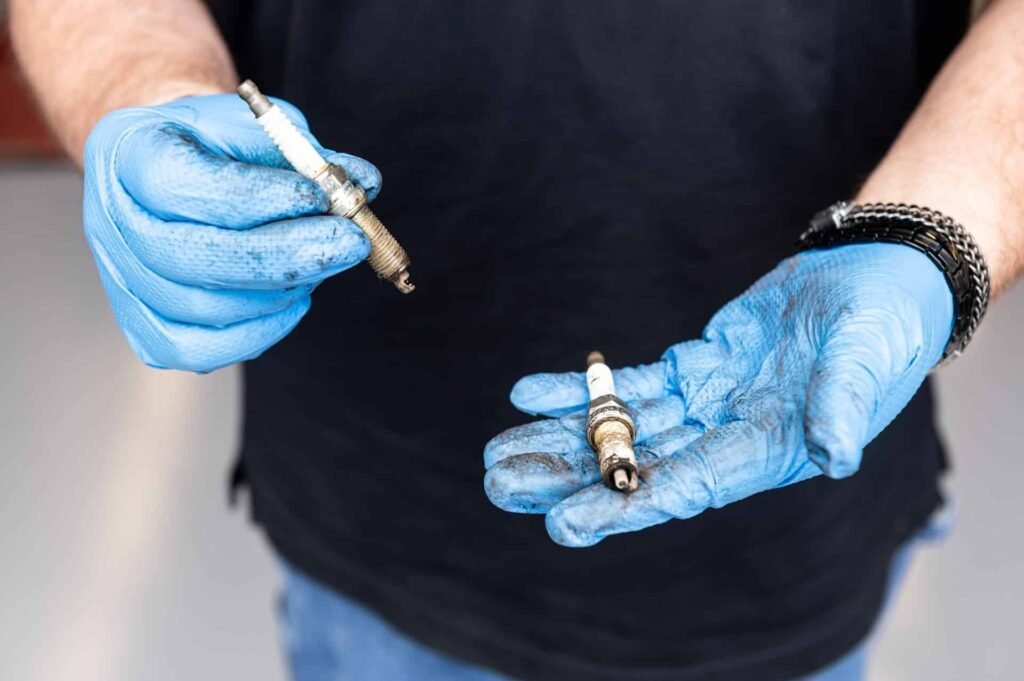
What Spark-Plug Condition Can Reveal
Removed spark plugs may provide clues about engine operation.
Possible findings include:
- Normal wear
- Excessive electrode wear
- Oil fouling
- Fuel fouling
- Carbon deposits
- Coolant contamination
- Overheating
- Mechanical damage
- Incorrect plug type
- Uneven condition between cylinders
Spark-plug appearance alone does not always identify the cause.
Additional testing may be needed when one or more plugs show abnormal deposits or damage.
Ignition Coil Inspection
Most modern gasoline engines use individual ignition coils or coil packs.
Ignition coils increase battery voltage so the spark plugs can ignite the mixture inside the cylinders.
A failing coil may cause:
- Misfire
- Rough idle
- Hesitation
- Loss of power
- Flashing check engine light
- Hard starting
- Poor fuel economy
- Catalytic-converter overheating
A misfire code associated with one cylinder does not automatically prove that the ignition coil has failed.
Other causes may include:
- Spark plug
- Fuel injector
- Wiring
- Connector
- Compression loss
- Vacuum leak
- Engine mechanical problem
Testing helps avoid replacing a serviceable coil.
Should All Ignition Coils Be Replaced Together?
Not automatically.
Ignition coils may be replaced:
- Individually when one confirmed coil has failed
- In groups when condition, age, access, repeated failures, or manufacturer guidance supports it
- As a complete set when the repair value and vehicle history justify it
The correct recommendation depends on:
- Vehicle design
- Coil age
- Mileage
- Failure pattern
- Parts quality
- Labor access
- Customer goals
- Condition of the spark plugs
We explain whether replacing one coil or more than one coil makes practical sense.
Ignition Wires, Distributor Caps, and Rotors
Some older vehicles use ignition wires, distributor caps, and rotors.
These components may deteriorate because of:
- Heat
- Age
- Electrical arcing
- Moisture
- Corrosion
- Cracking
- Carbon tracking
- Terminal wear
Possible symptoms include:
- Hard starting
- Rough running
- Misfire
- Poor wet-weather operation
- Visible arcing
- Reduced performance
These components should only be included in a tune-up when the vehicle is equipped with them and their condition or service interval supports replacement.
Engine Air-Filter Service
The engine air filter helps prevent dirt and debris from entering the engine.
A heavily restricted filter may contribute to:
- Reduced airflow
- Reduced performance
- Increased fuel use on some vehicles
- Contamination of intake-system components
- Additional load on the intake system
Replacement should be based on:
- Manufacturer recommendations
- Filter condition
- Driving environment
- Mileage
- Service history
A filter that appears dark is not always severely restricted.
Condition and airflow impact should both be considered.
Cabin Air Filter and Tune-Up Service
The cabin air filter is not part of engine combustion, but it is often reviewed during scheduled maintenance.
A restricted cabin filter may cause:
- Weak airflow from vents
- Increased blower noise
- Reduced defroster performance
- Musty odor
- Additional strain on the blower system
- Debris in the HVAC system
Cabin-filter service depends on:
- Vehicle design
- Manufacturer interval
- Filter condition
- Driving environment
- Customer preference
It should not be represented as an engine-performance repair.
PCV-System Inspection
The positive crankcase ventilation system helps manage pressure and vapors inside the engine.
Depending on the vehicle, the system may include:
- PCV valve
- Oil separator
- Hoses
- Check valves
- Diaphragms
- Integrated valve-cover components
A PCV-system concern may contribute to:
- Oil leaks
- Vacuum leaks
- Rough idle
- Whistling noise
- Oil consumption
- Check engine light
- Excessive crankcase pressure
- Intake contamination
PCV systems vary widely, and not every vehicle uses a separately replaceable valve.
Testing and inspection should match the engine design.
Throttle-Body Inspection
The throttle body controls airflow entering the engine.
Depending on the vehicle, it may be operated by:
- Mechanical cable
- Electronic motor
- Computer control
Deposits may form over time around the throttle plate and bore.
Possible symptoms may include:
- Rough idle
- Stalling
- Delayed throttle response
- Low idle
- High idle
- Throttle-related warning
- Airflow concerns
However, throttle-body deposits do not cause every idle problem.
Cleaning should be recommended when condition, symptoms, or manufacturer procedures support it.
Some vehicles require an idle relearn or electronic adaptation after service.
Fuel-System Service
The fuel system may include:
- Fuel pump
- Fuel injectors
- Fuel rail
- Pressure regulator
- Fuel filter
- Fuel-pressure sensor
- High-pressure pump on direct-injection engines
- Fuel lines
- Electronic controls
A tune-up does not automatically require fuel-injector cleaning or fuel-system additives.
Fuel-system service may be appropriate when supported by:
- Confirmed injector imbalance
- Deposits
- Restricted flow
- Poor spray pattern
- Manufacturer recommendation
- Diagnostic findings
- Fuel-quality concern
A fuel additive cannot repair a failed injector, weak pump, damaged wiring, or low compression.
Fuel-Injector Problems
A fuel injector may become:
- Restricted
- Leaking
- Electrically open
- Electrically shorted
- Mechanically stuck
- Contaminated
- Damaged
Possible symptoms include:
- Misfire
- Rough idle
- Hard starting
- Fuel odor
- Poor fuel economy
- Loss of power
- Excessive emissions
- Fuel in the engine oil
- Check engine light
Injector diagnosis may involve:
- Electrical testing
- Command testing
- Fuel-pressure testing
- Balance testing
- Cylinder contribution testing
- Scan-data review
- Inspection of spark plugs
Replacing injectors without testing may not correct the concern.
Direct-Injection Engine Considerations
Many modern gasoline engines use direct fuel injection.
These engines may use:
- High-pressure fuel pump
- High-pressure injectors
- Specialized fuel controls
- Additional sensors
- Complex fuel-pressure strategies
Because fuel is injected directly into the combustion chamber, it may not wash the back of the intake valves in the same way as some port-injected systems.
Certain engine designs may develop intake-valve deposits over time.
Possible symptoms may include:
- Rough cold start
- Misfire
- Reduced performance
- Poor airflow
- Check engine light
Intake cleaning should be based on engine design, symptoms, and confirmed deposit concerns—not automatically included with every tune-up.
Vacuum and Intake Leaks
Unmetered air entering the engine may affect the air-fuel mixture.
Possible leak sources include:
- Cracked vacuum hose
- Intake boot
- Intake-manifold gasket
- PCV system
- Brake-booster hose
- Evaporative-emissions hose
- Throttle-body gasket
- Damaged plastic intake component
Possible symptoms include:
- Rough idle
- High idle
- Lean trouble codes
- Hesitation
- Misfire
- Whistling
- Reduced fuel economy
Smoke testing or other diagnostic methods may be needed to locate a small leak.
Replacing tune-up parts will not repair an intake leak.
Fuel Economy Concerns
Reduced fuel economy may have many possible causes.
These include:
- Short-trip driving
- Stop-and-go traffic
- Cold weather
- Low tire pressure
- Heavy vehicle loading
- Roof racks or cargo
- Engine-temperature concern
- Misfire
- Worn spark plugs
- Airflow-sensor concern
- Oxygen-sensor concern
- Fuel-injector problem
- Brake drag
- Alignment
- Incorrect fluids
- Driving habits
A tune-up may help when overdue maintenance is affecting engine operation.
It will not automatically restore fuel economy when the cause is unrelated to tune-up components.
Rough Idle Diagnosis
A rough idle may be caused by:
- Worn spark plugs
- Ignition coil
- Fuel injector
- Vacuum leak
- Throttle-body concern
- Engine mount
- Compression loss
- Valve problem
- Timing concern
- Sensor fault
- Fuel-pressure problem
- Contaminated fuel
- PCV-system problem
The conditions under which the roughness occurs are important.
For example:
- Rough only when cold
- Rough only when warm
- Rough with air conditioning on
- Rough after refueling
- Rough at idle but smooth while driving
- Rough under acceleration
Diagnosis helps distinguish between maintenance needs and repair concerns.
Engine Misfire Diagnosis
A misfire occurs when one or more cylinders do not produce the expected combustion event.
Possible causes include:
- Spark plug
- Ignition coil
- Ignition wire
- Fuel injector
- Vacuum leak
- Low compression
- Valve damage
- Head gasket concern
- Mechanical timing
- Wiring
- Sensor input
- Contaminated fuel
A flashing check engine light may indicate a severe misfire that could overheat and damage the catalytic converter.
When the light flashes and the vehicle runs poorly, reduce driving and arrange prompt inspection.
Hard-Starting Problems
Hard starting may involve:
- Weak battery
- Starter concern
- Worn spark plugs
- Ignition coil
- Fuel-pressure loss
- Leaking injector
- Sensor fault
- Vacuum leak
- Compression loss
- Engine timing
- Anti-theft system
- Electrical connection
- Temperature-related control issue
A tune-up may help if overdue spark plugs or ignition maintenance are responsible.
Testing is needed when the cause is not clear.
Engine Hesitation and Loss of Power
Hesitation or reduced power may involve:
- Ignition misfire
- Fuel-delivery concern
- Airflow sensor
- Throttle-body problem
- Restricted exhaust
- Turbocharger concern
- Transmission issue
- Vacuum leak
- Engine timing
- Low compression
- Clogged filter
- Control-module strategy
The engine, transmission, fuel, ignition, air-intake, and exhaust systems may all affect acceleration.
A broad diagnosis may be needed before tune-up service is selected.
Check Engine Light and Tune-Up Service
A check engine light means the vehicle computer detected a fault in a monitored system.
It does not automatically mean the vehicle needs a tune-up.
Possible causes include:
- Ignition misfire
- Emissions leak
- Oxygen sensor
- Catalytic converter
- Fuel control
- Airflow sensor
- Engine-temperature concern
- Transmission fault
- Electrical circuit
- Variable valve timing
- Turbocharger system
Trouble codes help guide testing, but they do not always identify the failed component directly.
Clearing the light without diagnosing the cause does not repair the vehicle.
Tune-Up Service for Older Vehicles
Older vehicles may require tune-up components no longer found on modern engines.
These may include:
- Distributor cap
- Rotor
- Ignition wires
- Adjustable ignition timing
- Carburetor adjustments
- Mechanical idle adjustments
- Choke components
The proper service depends on the vehicle’s actual design.
We do not apply modern procedures to older systems or outdated procedures to computer-controlled vehicles.
Tune-Up Service for Turbocharged Engines
Turbocharged engines may place additional demands on:
- Spark plugs
- Ignition coils
- Engine oil
- Cooling system
- Fuel system
- Air-intake system
- Charge-air hoses
- PCV system
A turbocharged engine may be more sensitive to:
- Incorrect spark plugs
- Incorrect plug gap
- Low-quality fuel
- Boost leaks
- Ignition misfire
- Low oil level
- Extended oil-service intervals
Tune-up service should follow the manufacturer’s requirements for the specific turbocharged engine.
Tune-Up Service for Hybrid Vehicles
Hybrid vehicles still use gasoline engines that require scheduled maintenance.
Depending on the vehicle, maintenance may include:
- Spark plugs
- Engine air filter
- Engine oil
- Cooling-system service
- PCV inspection
- Fuel-system evaluation
- Engine-performance checks
Hybrid engine operation may involve frequent starts and stops and different warm-up patterns.
The manufacturer’s maintenance schedule still applies even when the gasoline engine runs less often than in a conventional vehicle.
Tune-Up Service for High-Mileage Vehicles
A high-mileage vehicle may need a more condition-based approach.
Important considerations may include:
- Oil consumption
- Compression
- Fluid leaks
- Misfire history
- Ignition-coil age
- Spark-plug condition
- Fuel-injector operation
- Timing-component history
- PCV-system condition
- Cooling-system condition
- Maintenance records
A high-mileage engine does not automatically need every possible tune-up item.
We help prioritize the services that are due and identify symptoms that require diagnosis.
Tune-Up Service with Unknown Maintenance History
A used vehicle or one without complete records may need a baseline review.
This may include checking:
- Spark-plug interval
- Air-filter condition
- Ignition components
- Fluid levels
- Belts and hoses
- PCV components
- Warning lights
- Engine performance
- Manufacturer maintenance schedule
- Visible service labels or records
We avoid claiming a service was never performed simply because documentation is missing.
However, if the service cannot be confirmed and the vehicle is beyond the expected interval, maintenance may be recommended based on risk, condition, mileage, and age.
Why Tune-Up Costs Vary
Tune-up costs vary because vehicles differ in:
- Number of cylinders
- Spark-plug type
- Spark-plug access
- Intake-manifold removal requirements
- Ignition-system design
- Parts quality
- Manufacturer procedures
- Diagnostic needs
- Engine configuration
- Additional findings
On some engines, spark plugs are easily accessible.
On others, access may require removal of:
- Intake manifold
- Engine covers
- Ignition components
- Brackets
- Air-intake assemblies
- Other vehicle-specific parts
A meaningful estimate must be based on the specific vehicle and approved service.
Why Proper Tune-Up Recommendations Matter
Too little maintenance may contribute to:
- Misfire
- Poor performance
- Increased emissions
- Reduced reliability
- Catalytic-converter damage
- Hard starting
- Additional ignition-system stress
Unnecessary maintenance wastes money and may not improve vehicle operation.
A practical tune-up plan should:
- Follow manufacturer requirements
- Consider mileage and time
- Review service history
- Inspect actual condition
- Diagnose active symptoms
- Avoid automatic add-on services
- Use correct vehicle-specific parts
- Verify the result
Our approach is to inspect, test when necessary, explain, and then perform the approved service.
Preventing Tune-Up and Drivability Problems
Helpful steps include:
- Follow the manufacturer’s spark-plug interval
- Replace filters when due
- Use the correct spark plugs
- Maintain the correct engine oil
- Address check engine lights promptly
- Investigate misfires
- Repair vacuum or intake leaks
- Maintain the battery and charging system
- Address fuel-quality concerns
- Repair oil leaks into spark-plug wells
- Keep maintenance records
- Avoid driving with a flashing check engine light
- Have unusual starting or performance changes inspected
- Use vehicle-specific parts and procedures
Regular maintenance cannot prevent every engine problem, but it can reduce avoidable ignition and performance concerns.
Why Choose Chuck’s Auto Repair – North Seattle?
- AAA-approved auto repair facility
- ASE-certified technicians
- Trusted by Seattle-area drivers for more than 30 years
- Vehicle-specific tune-up recommendations
- Manufacturer-scheduled spark-plug service
- Ignition, intake, fuel, and PCV-system inspection
- Diagnosis before unnecessary parts replacement
- Modern and older ignition-system experience
- Clear separation between maintenance and repair
- Correct vehicle-specific parts and procedures
- 24-month / 24,000-mile parts and labor warranty
- 12-month / 12,000-mile nationwide warranty coverage
- Convenient North Seattle location
We do not treat every vehicle as though it needs the same tune-up package.
We review the engine, mileage, maintenance history, manufacturer schedule, and current symptoms before recommending service.
Warranty Protection for Qualifying Tune-Up Repairs
Qualifying repairs completed as part of tune-up or engine-performance service are backed by our 24-month / 24,000-mile parts and labor warranty.
The warranty also includes 12-month / 12,000-mile nationwide coverage, providing additional protection if you need warranty assistance while traveling away from Seattle.
The nationwide 1-800 assistance information is printed on every repair invoice. Customers also receive a warranty keytag for convenient access while on the road.
Warranty coverage depends on the service or repair performed, parts installed, and applicable terms.
Convenient Tune-Up Service in North Seattle
Chuck’s Auto Repair – North Seattle
9115 Roosevelt Way NE
Seattle, WA 98115
We provide tune-up inspections, scheduled engine maintenance, spark-plug replacement, and drivability diagnostics for drivers throughout:
Maple Leaf • Roosevelt • Northgate • Green Lake • Wedgwood • University District • Ravenna • Lake City • Wallingford • Greenwood
📞 Call (206) 526-1069 to schedule tune-up service.
Tune-Up FAQs
What is included in a modern tune-up?
A modern tune-up may include spark plugs, ignition inspection, filters, PCV-system inspection, throttle-body evaluation, maintenance review, and engine-performance checks. The exact service depends on the vehicle.
How often does my vehicle need a tune-up?
There is no universal interval. Spark plugs, filters, and other items have vehicle-specific mileage and time requirements.
Does every tune-up include spark plugs?
No. Spark plugs should be replaced when due by the manufacturer schedule or when condition and diagnostic findings support replacement.
Can a tune-up turn off the check engine light?
Only when the fault is caused by an item corrected during the service. The light should be diagnosed rather than assuming a tune-up will fix it.
Can worn spark plugs reduce fuel economy?
They may contribute to poor combustion, misfire, or reduced efficiency. Fuel economy can also be affected by many non-ignition concerns.
Can a tune-up fix a rough idle?
Sometimes, but rough idle may also involve a vacuum leak, injector, sensor, throttle body, compression, timing, mount, or other engine concern.
What causes an engine misfire?
Possible causes include spark plugs, ignition coils, injectors, wiring, vacuum leaks, compression loss, valve damage, timing concerns, or fuel problems.
Should all ignition coils be replaced with the spark plugs?
Not automatically. Coil replacement should be based on confirmed failure, condition, history, access, or a practical repair strategy.
Should ignition coils be replaced in sets?
Sometimes, but not always. The recommendation depends on vehicle design, age, mileage, failure history, and labor access.
What happens if spark plugs are left in too long?
Extended service may contribute to misfire, hard starting, reduced performance, coil stress, plug wear, or difficulty removing the plugs.
Can old spark plugs damage ignition coils?
Worn plugs may require higher ignition voltage and can place additional demand on coils, but coil failure can also occur for other reasons.
Does a tune-up include fuel-injector cleaning?
Not automatically. Injector or fuel-system cleaning should be based on symptoms, deposits, manufacturer guidance, and diagnostic evidence.
Does a tune-up include throttle-body cleaning?
Only when condition, symptoms, or manufacturer procedures support it.
Can a dirty air filter cause a check engine light?
A severely restricted filter or related airflow concern may affect engine operation, but many check engine light causes are unrelated to the filter.
Why does my car run rough only when cold?
Possible causes include ignition, fuel, intake deposits, vacuum leaks, temperature sensors, compression, or control-system concerns.
Why does my car hesitate when accelerating?
Possible causes include ignition misfire, fuel delivery, airflow, throttle control, vacuum leaks, transmission concerns, or engine mechanical problems.
What does a flashing check engine light mean?
It may indicate a severe misfire that could damage the catalytic converter. Reduce driving and arrange prompt inspection.
Can a tune-up improve acceleration?
It may help when overdue maintenance is causing poor combustion or restricted airflow. It will not correct every cause of reduced power.
Does a hybrid vehicle need tune-up service?
Yes. Hybrid vehicles still have gasoline engines that may require spark plugs, filters, fluids, and other scheduled maintenance.
How long does tune-up service take?
Timing depends on the engine, spark-plug access, number of cylinders, diagnostic needs, and additional approved services.
Do tune-up repairs include a warranty?
Qualifying repairs are backed by our 24-month / 24,000-mile parts and labor warranty, including 12-month / 12,000-mile nationwide warranty coverage.
Schedule Tune-Up Service in North Seattle
If your vehicle is due for spark plugs, has an unknown maintenance history, starts poorly, idles roughly, hesitates, misfires, or has lost performance, schedule an inspection with Chuck’s Auto Repair – North Seattle.
Our ASE-certified technicians will review the manufacturer’s maintenance requirements, inspect the engine and ignition system, diagnose active performance concerns, and recommend only the services and repairs supported by the vehicle’s condition.
📞 Call (206) 526-1069 or Book Tune-Up Service Online.