Wildfire Smoke and Your Commute: What Your Cabin Air Filter Actually Does
If you have driven Roosevelt Way NE, Lake City Way, 15th Ave NE, or sat in northbound I-5 traffic during smoke season, you have probably noticed it: that campfire smell coming through the vents.
It is easy to think of your vehicle as a sealed bubble, but most cars are not sealed from outside air. Depending on your HVAC setting, your vehicle may be pulling outside air into the cabin and sending it through the vents. During wildfire smoke season, that matters.
Your cabin air filter helps clean the air before it reaches the inside of the vehicle. But it is important to understand what it can do, what it cannot do, and why the recirculate button may be one of the most useful controls on your dashboard during smoky conditions.
At Chuck’s Auto Repair – North Seattle, we see a lot of vehicles that spend their lives in North Seattle traffic, short-trip commuting, wet leaves, road grit, and seasonal smoke. Cabin filters and engine air filters are small parts, but when they are neglected, they can affect airflow, odors, visibility, and comfort.
What a Cabin Air Filter Actually Does
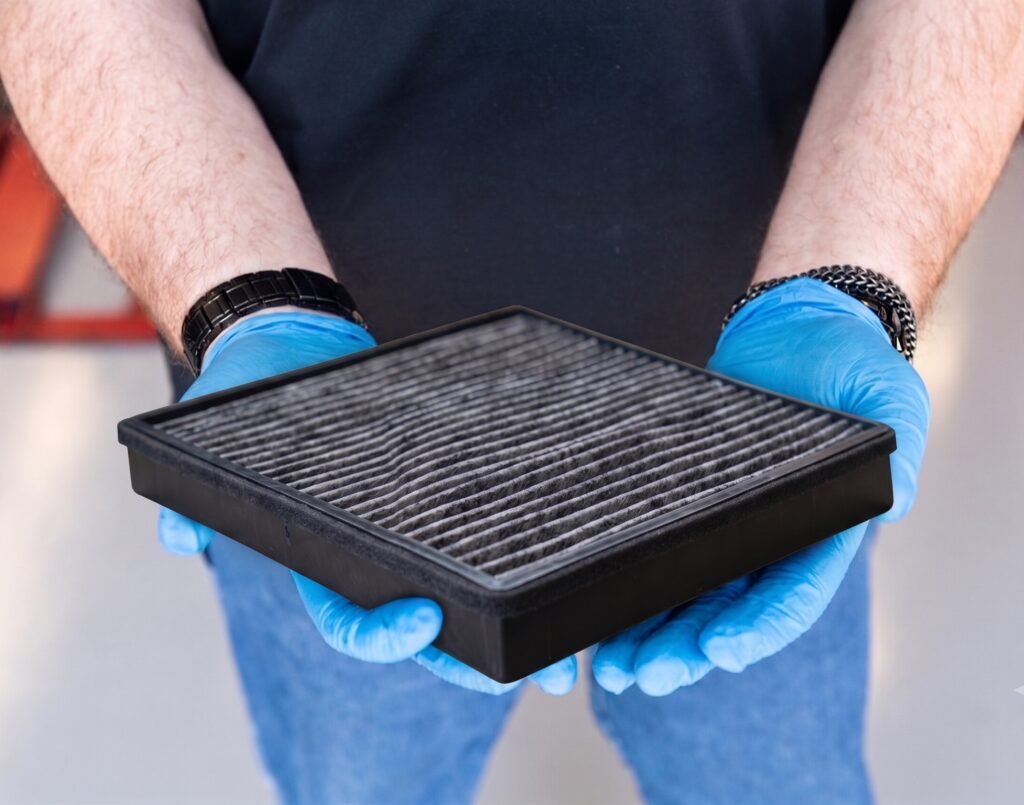
Your cabin air filter sits in the HVAC system and filters the air before it comes through the vents. On a normal North Seattle driving day, it helps catch:
- Pollen
- Road dust
- Leaf debris
- Brake dust
- Bugs and small debris
- General city grit
- Some airborne particles, depending on filter type
Most cabin filters are located behind the glovebox or under the dash area, although access varies by vehicle.
When the filter is clean and properly fitted, air can move through the HVAC system more easily. When the filter is packed with dirt, leaves, and debris, airflow drops. That can make the fan seem weak, make defrosting slower, and make odors worse when the blower first turns on.
The Honest Part: Wildfire Smoke Is Different
A standard cabin air filter is not the same thing as a respirator, and your car is not a clean-room. Wildfire smoke includes very small particles, especially PM2.5, which are fine particles 2.5 microns and smaller. EPA identifies PM2.5 as the pollutant of greatest health concern in wildfire smoke because these particles can get deep into the lungs.
That does not mean your cabin filter is useless. It means we should be honest about what it is.
A clean basic cabin filter is better than a clogged, neglected one. But a basic filter may not capture fine smoke particles as well as a higher-efficiency filter. If smoke smell and fine particles are the concern, filter type matters.
Common cabin filter options include:
Standard particulate cabin filters
These are the basic filters found in many vehicles. They help with larger particles such as dust, pollen, leaves, and debris.
Activated carbon cabin filters
These add a carbon layer that can help reduce odors. For smoke season, this can help with the smell inside the vehicle.
High-efficiency cabin filters
Some aftermarket filters use denser or more advanced media designed to capture smaller particles than a basic filter. Fitment and airflow still matter, so the right choice depends on the vehicle.
Combination carbon + high-efficiency filters
These are often the best practical upgrade for drivers who want help with both smoke smell and fine-particle filtration, when a proper fit is available for the vehicle.
The key is choosing a filter that fits correctly and does not create an airflow problem for your specific HVAC system.
The Free Thing That Helps Most: Use Recirculate Mode
During smoky driving conditions, the recirculate button matters.
EPA recommends reducing smoke in your vehicle by closing the windows and running the air conditioner in recirculate mode. Washington Department of Ecology also recommends keeping car windows up and setting the A/C to recirculate to avoid bringing in dirty air.
The recirculate button usually looks like a car outline with an arrow looping inside. When activated, it reduces how much outside air the HVAC system pulls in and instead cycles air that is already inside the cabin.
During smoke season, that can help because the system is not constantly pulling smoky outside air into the vehicle.
A practical setup for smoky conditions:
- Windows up
- A/C on
- Recirculate mode on
- Cabin filter clean and properly fitted
- Avoid unnecessary trips when air quality is poor
- Check local air quality before longer drives
One caution: Washington DOH notes that carbon dioxide can build up in vehicles using recirculation and may cause sleepiness, especially over longer periods. For normal short trips around North Seattle, recirculate mode is often useful. For longer drives, pay attention to fatigue, fogging windows, and ventilation needs.
Signs Your Cabin Air Filter Is Overdue
North Seattle driving can be hard on cabin filters. Stop-and-go commuting, wet leaves, construction dust, pollen, smoke, and road grit all add up.
Have your cabin filter checked if you notice:
- Weak airflow from the vents
- A musty, sour, or smoky smell when the fan comes on
- Windows that take longer than normal to defog
- A whistling or straining sound from the vents
- Blower noise that seems louder than it used to be
- Dust or debris coming from the vents
- Allergy symptoms that seem worse inside the car
A clogged filter does more than smell bad. It can restrict airflow through the HVAC system. When the blower motor has to work against extra restriction, it may create extra noise, poor airflow, and added strain on the system.
That does not mean every blower problem is caused by a cabin filter. Weak airflow can also come from blower motor issues, resistor or control problems, blend door concerns, evaporator restriction, or electrical faults. But the filter is one of the easiest and most logical first checks.
What About the Engine Air Filter?
Your engine has its own air filter, separate from the cabin air filter.
The cabin air filter is for the air you breathe inside the car. The engine air filter is for the air the engine uses for combustion.
During smoke season, both can matter. Smoke, ash, dust, and road debris can load up the engine air filter too. A restricted engine air filter can affect airflow into the engine and may contribute to reduced performance or fuel economy depending on the vehicle and operating conditions.
That is why it makes sense to check both filters during seasonal maintenance, especially if the vehicle has been driven through smoky or dusty conditions.
What Chuck’s Auto Repair – North Seattle Checks
When you bring your vehicle to Chuck’s Auto Repair – North Seattle, our team can inspect the cabin air filter and related HVAC airflow concerns as part of routine maintenance or an air conditioning concern.
Depending on the vehicle and symptoms, we may check:
- Cabin air filter condition
- Filter fitment
- Debris in the filter housing
- Blower airflow
- Odor concerns
- Defroster performance
- A/C operation
- Engine air filter condition
- Related maintenance needs based on inspection and service history
If the filter is dirty, we can show you what came out. Often, the before-and-after tells the story better than anything else.
If the filter looks fine, we will tell you that too. The goal is not to replace parts for no reason. The goal is to help you understand what needs attention now, what can be planned, and what is not actually a problem.
That inspection-first approach fits the way maintenance should be handled: based on the vehicle, mileage, service history, and what we actually find.
Is a Cabin Air Filter Enough During Wildfire Smoke?
No. A cabin air filter is not a medical device, a respirator, or a guarantee that the air inside your vehicle is safe.
If air quality is poor, the best protection is to reduce exposure where possible. EPA’s guidance for smoke exposure includes reducing time in smoky air and using recirculate mode in the vehicle if driving is necessary.
So the honest answer is:
A good cabin air filter helps.
Recirculate mode helps.
Keeping windows closed helps.
Avoiding unnecessary smoke exposure helps most.
For North Seattle drivers who still need to commute, pick up kids, get to work, or run unavoidable errands, a clean and properly chosen cabin filter is a smart seasonal maintenance item.
When to Schedule a Filter Check
Consider having your cabin air filter and engine air filter checked:
- At the start of wildfire smoke season
- After several smoky driving days
- If airflow from the vents feels weak
- If the car smells musty or smoky inside
- If the windshield is slow to defog
- Before a long summer road trip
- During routine maintenance or an oil service
- If you do not know when the filters were last replaced
Many drivers do not think about the cabin air filter until the smell gets bad or the vents feel weak. By then, the filter may already be packed with debris.
Schedule Service in North Seattle
If smoke season has made your commute uncomfortable, or if your vents smell musty, smoky, or weak, have your filters and HVAC airflow checked.
Call Chuck’s Auto Repair – North Seattle at 206-526-1069 or schedule auto repair online. Our team will inspect the vehicle, explain what we find, and help you understand what needs attention now and what can be planned.
You can also visit us at 9115 Roosevelt Way NE, Seattle, WA 98115, on Roosevelt Way NE in Maple Leaf / North Seattle.