
If two tires on your Toyota RAV4 are worn out, replacing just those two sounds like the obvious answer.
On an AWD RAV4, it isn’t always that simple.
We recently inspected a 2013 Toyota RAV4 Limited AWD at Chuck’s Auto Repair – North Seattle.
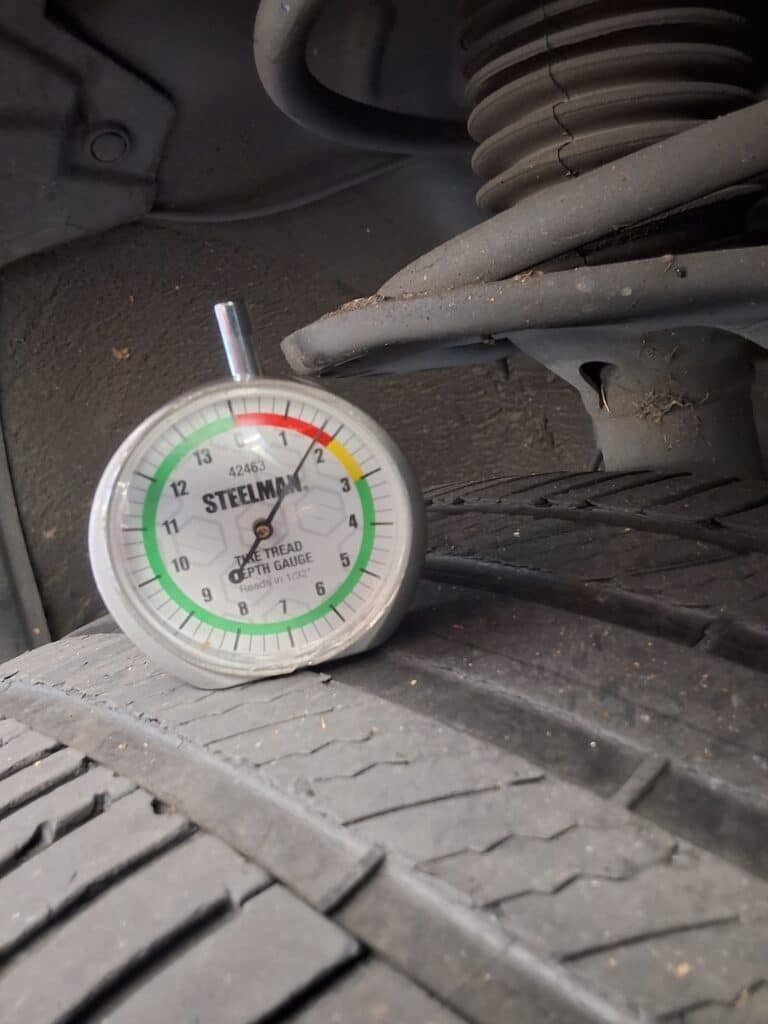
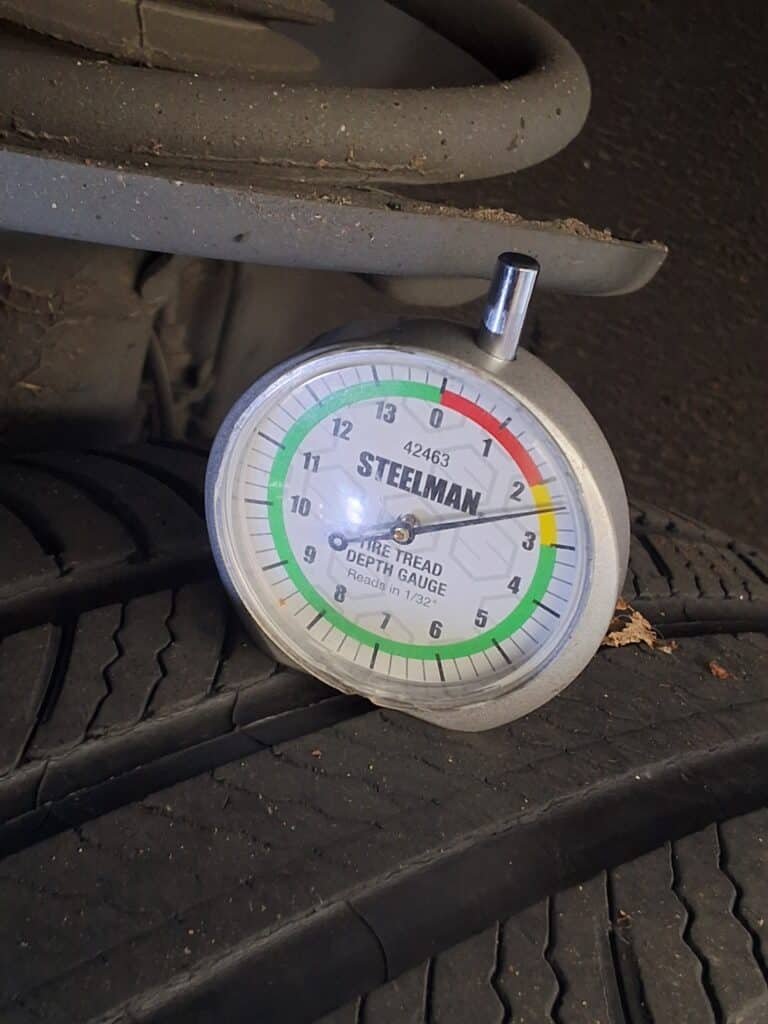
The tread measurements were very different front to rear:
Front left: 2.5/32″
Front right: 1.5/32″
Rear left: 5.5/32″
Rear right: 5.5/32″
So the owner’s reasonable question could have been:
If the front tires are the ones worn out, why replace all four?
The answer comes down to something an AWD system cares about that isn’t obvious just by looking at the tires:
how closely the tires match each other as they roll down the road.
Toyota also cautions RAV4 owners against mixing tires with markedly different treadwear.
On this particular RAV4, the difference was large enough that we recommended replacing the four tires as a matched set rather than putting two new tires next to the substantially less worn rear pair.
The Front Tires and Rear Tires Were No Longer Wearing as a Matched Set
The numbers make this easier to understand.
The rear tires both measured 5.5/32″.
The left front measured 2.5/32″.
That’s about a 3/32″ difference compared with the rear tires.
The right front measured only 1.5/32″.
That’s about a 4/32″ difference compared with the rears.
We aren’t applying some made-up rule that says:
“Every AWD vehicle must be within exactly X/32 of an inch.”
Toyota doesn’t publish a universal tread depth number like that for this 2013 RAV4.
But Toyota does warn against running tires with remarkably different treadwear, and that’s why the actual tread measurements matter.
Why Does Tread Depth Matter to an AWD System?
A tire isn’t just a round piece of rubber with tread on it.
As tread wears away, the tire’s effective rolling size changes slightly.
That means a substantially worn tire does not roll exactly the same way as a tire with much more tread remaining.
An AWD vehicle is designed around four tires working together.
When there is a major difference between the tires, the drivetrain and vehicle control systems may see wheel speed differences that weren’t intended to be there.
That’s why tire matching matters more than simply asking:
“Which two tires still have tread?”
Toyota’s own guidance for the 2013 RAV4 tells owners not to mix tires of different makes, models or tread patterns and not to mix tires with remarkably different treadwear. Toyota also instructs owners to use tires of the specified size and warns that mismatched tires can affect drivetrain components and vehicle handling.
Toyota Doesn’t Give Us a Magic 2/32″ Rule
This is important because you’ll see a lot of numbers online.
Someone may say:
“AWD tires always have to be within 2/32.”
Someone else may say:
“3/32 is okay.”
Another article might quote a completely different number.
For this 2013 RAV4, Toyota’s owner guidance does not give us a universal numerical tread depth difference limit.
Instead, Toyota warns against remarkably different treadwear and tells us the tires should be properly matched.
So we’re not going to invent a Toyota specification that isn’t there.
We inspect and measure the tires on the actual vehicle, look at the size and tire configuration, and make the recommendation based on what we find.
This RAV4 Had a Real Front to Rear Difference
On this vehicle, we didn’t have to guess whether the tread wear was different.
We measured it.
The right front was 1.5/32″.
The left front was 2.5/32″.
Both rear tires still had 5.5/32″.
That is visibly and measurably different tire wear across the AWD system.
Putting two brand new tires on the front while leaving the significantly worn rear pair in place would create another front to rear difference, this time in the opposite direction.
For this RAV4, the cleanest way to restore a matched tire set was to replace all four.
Why Can’t You Judge This Just by Looking at the Tires?
A tire can look like it still has tread and still be substantially different from the tire on the other end of the vehicle.
That’s why we measure.
On this RAV4, the important information wasn’t:
“The fronts look kind of worn.”
It was:
1.5/32″
2.5/32″
versus
5.5/32″ and 5.5/32″.
Those measurements give us something objective to discuss with the owner.
They also help separate a genuine AWD tire matching recommendation from a blanket:
“It’s AWD, so you always have to buy four tires.”
Does AWD Always Mean You Must Replace Four Tires?
No.
That’s not the rule we’re using.
If an AWD vehicle has a damaged tire and the other tires are still very close in condition, the correct decision may depend on the exact vehicle, existing tire condition and manufacturer guidance.
But when tire wear has become substantially uneven across the vehicle, the conversation changes.
On this RAV4, we had two heavily worn front tires and two significantly less worn rear tires.
Toyota’s own tire guidance tells us not to mix tires with remarkably different treadwear.
For this vehicle, four matched tires made sense.
What About Replacing Only the Two Front Tires?
That seems logical because those were the tires that were worn out.
The issue is that the new pair would then have far more tread than the existing 5.5/32″ rear tires.
In other words, simply replacing the worn axle tire doesn’t automatically make all four tires match again.
This is why AWD tire replacement can be different from the decision on some two wheel drive vehicles.
The goal isn’t to sell the maximum number of tires.
The goal is to put the vehicle back on a tire set that works properly together.
Tire Brand, Size and Tread Pattern Matter Too
Tread depth isn’t the only matching issue.
Toyota’s guidance also cautions against mixing tires of different:
makes
models
tread patterns
and
construction types
and says to use the recommended tire size.
Toyota’s driving system guidance also says the tires should be the specified size, brand, tread pattern and load capacity, and warns that installing different tires can interfere with ABS, TRAC and VSC operation.
That’s why an AWD tire recommendation isn’t simply:
“Find another tire that’s round and the same diameter printed on the sidewall.”
The complete tire setup matters.
Why Were the Front Tires So Much More Worn?
The inspection tells us what the tire depths were.
It doesn’t prove exactly why they reached those measurements.
There can be many reasons tires wear at different rates, including rotation history, alignment, inflation, driving conditions and normal front to rear wear patterns.
We shouldn’t invent a cause when the inspection doesn’t establish one.
What we can say is that this RAV4 had a measurable mismatch when it arrived.
That’s the condition we had to make a tire recommendation around.
The Customer Approved Four Tires
After the inspection and recommendation, the owner approved replacement of all four tires.
That matters to this article because we’re not describing a theoretical example.
This is a real AWD RAV4 that came through our North Seattle shop.
The technician measured all four tires.
The front to rear difference was documented.
The recommendation was discussed.
And the vehicle received a matched set of four tires.
This RAV4 Had Other Findings, But They Aren’t the Point of This Story
The inspection also found other maintenance and suspension items.
For example, the vehicle had prior recommendations involving worn suspension bushings and struts, and the front struts were replaced during this visit.
There were also service history questions involving spark plugs and transmission fluid.
Those are legitimate maintenance topics of their own.
However the useful lesson from this RAV4 is much simpler:
On an AWD vehicle, the condition of all four tires can matter even when only two are obviously worn out.
What Should You Do If One or Two Tires on Your AWD RAV4 Need Replacement?
Don’t assume you automatically need four.
But don’t assume two is always safe either.
Have all four tires measured.
We want to know:
How much tread remains on each tire?
Are all four the same size?
Are the make, model and tread pattern compatible?
Is there uneven wear?
What does Toyota specify for the vehicle?
Once we have those answers, we can explain whether replacing one, two or all four tires makes sense for your RAV4.
That’s a much better decision than guessing from the odometer or looking at only the damaged tire.
AWD Toyota RAV4 Tire FAQ
Does Toyota say an AWD RAV4 always needs four new tires?
No. Toyota’s 2013 RAV4 guidance does not say that every tire replacement automatically requires four tires. It does warn against mixing tires with remarkably different treadwear and against mismatching tire make, model, tread pattern, construction or recommended size.
Does Toyota have a 2/32-inch AWD tire rule?
We did not find a universal 2/32″ tread-difference rule in the 2013 RAV4 owner’s manual. That’s why we don’t present one as a Toyota specification.
What were the actual tire measurements on this RAV4?
The front tires measured approximately 2.5/32″ and 1.5/32″, while both rear tires measured 5.5/32″.
Why can different tire tread depths matter on AWD?
As tires wear, their effective rolling size changes. Large differences mean the tires do not roll identically, which is why AWD vehicles and their control systems benefit from a properly matched tire set.
Can I just replace the two worn tires?
Sometimes two tire replacement may be appropriate, depending on the vehicle and the condition of the remaining tires. On this RAV4, the actual tread measurements and Toyota’s tire matching guidance supported replacing all four.
Do you have to inspect the tires first?
Yes. The recommendation should come from the actual tire sizes, tread depths, wear pattern and vehicle configuration rather than from the letters “AWD” alone.
Toyota RAV4 Tire Service in North Seattle
If your AWD Toyota needs one or two tires, you don’t have to figure out ahead of time whether you need two tires or four.
We can measure all four, check the tire configuration and explain what makes sense for the vehicle in front of us.
Chuck’s Auto Repair – North Seattle
9115 Roosevelt Way NE
Seattle, WA 98115
206-526-1069
Schedule online clicking here.